
Approved by Educators. Loved by Kids.
Tynker’s Award-Winning Coding Program
300 learning modules across six certification levels transform your child from beginner to expert. With 70+ courses, Tynker has taught more than 100 million kids across 150 countries how to code.
MicroPython Studio
Introduce your class to physical computing with micro:bit and MicroPython. This course is an advanced introduction to micro:bit and requires prior Python programming knowledge. The curriculum engages campers as they see their abstract programs come to life on a tangible physical device that they can control with their hands. Using built-in micro:bit sensors, buttons, and the 5X5 LED display, campers build animated LED emojis, real-world temperature sensors, pedometers, multiplayer games, and even a two-way Morse code radio. The course includes 16 hands-on projects with step-by-step instructions. It is delivered in an interactive notebook-style lesson format so that campers can learn new concepts, write programs, and deploy code to the micro:bit right from the lesson interface. There is nothing to download or install on your computer. In addition, campers can also launch Tynker Code Editor and write their own programs from scratch. The lesson plans in this course build and reinforce STEM skills, problem solving, debugging, and collaboration skills as campers bridge digital and physical learning. Students wiil apply abstract programming concepts to create tangible hands-on micro:bit-based inventions. Each lesson is designed for a class period of 45-60 minutes. All campers work is automatically tracked and assessed, and you'll be able to monitor individual progress and mastery charts for your campers. This course is recommended for advanced campers who are already familiar with Python. Beginner campers may enroll in micro:Bit 101 where they use Tynker Blocks to program micro:bit. This course is supported online and not supported on iPad. Recommended Accessories: This course requires micro:bit devices (not included). You may purchase these separately at a variety of resellers. Each lesson has a detailed Parts List. micro:bit, USB cable, Battery pack, 2xAAA batteries (for each camper or group) Accessories: Lessons 13, 14 require a Piezo speaker and Alligator clips Lessons 15,16 require two or more micro:bits Optional: microBit Inventor’s Kit: Classroom Pack (includes accessories required for all lessons) While most lessons need a single micro:bit, it is encouraged that campers improvise to create inventions that incorporate external cables, LEDs, speakers, aluminum foil, and other accessories, when available. See the this section on the micro:bit foundation for more ideas! Topics Covered: micro:bit Python commands, 2-way radio communication, deploying code to the micro:bit, light and temperature sensing, reading sensor values, gestures and motion detection, Programming the LED grid, multiplayer game development
Python 101 (Old)
An introduction to Python for intermediate or advanced coders in upper middle or high school. In this advanced lesson plan, students will be introduced to Python as they complete engaging lessons, solve challenging puzzles, and build their own games in Python. This course is ideal for students who have already completed at least one Tynker course and are comfortable with the basics of programming logic and computational thinking. This course will help them transition to Python and adapt to the additional challenges of text-based syntax.Students who successfully complete this lesson plan will demonstrate a strong mastery of Python syntax, as well as the ability to creatively program games and other projects and debug their own code. Students will also be able to come up with an idea for a game and take it through the entire design and implementation process, creating custom versions of many of their favorite games in Python.Topics Covered: Python syntax, sequencing, repetition, conditional logic, nested loops, automation, pattern recognition, simple motion, keyboard and mouse events, pen drawing, operators, expressions, variables, Turtle graphics, using arrays and objects to store structured data.
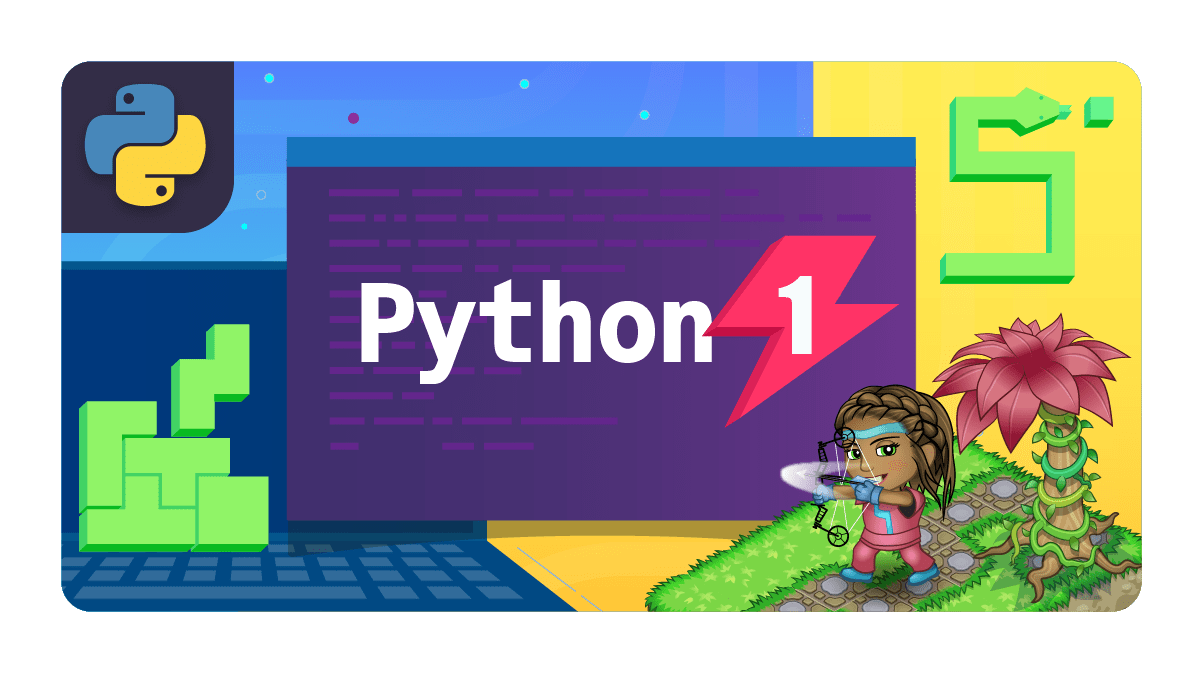
Python 1 (2020)
Get introduced to Python as you solve coding puzzles, learn to code games, and complete programming activities.
Python Coding
Introduction to Python for intermediate or advanced coders in upper middle or high school. In this advanced lesson plan, students will be introduced to Python as they complete engaging lessons, solve challenging puzzles, and build their own games in Python. This course is ideal for students who have already completed at least one Tynker course and are comfortable with the basics of programming logic and computational thinking. This course will help them transition to Python and adapt to the additional challenges of text-based syntax.Students who successfully complete this lesson plan will demonstrate a strong mastery of Python syntax, as well as the ability to creatively program games and other projects and debug their own code. Students will also be able to come up with an idea for a game and take it through the entire design and implementation process, creating custom versions of many of their favorite games in Python.Topics Covered: Python syntax, sequencing, repetition, conditional logic, nested loops, automation, pattern recognition, simple motion, keyboard and mouse events, pen drawing, operators, expressions, variables, Turtle graphics, using arrays and objects to store structured data.
Python Coding (2020)
Introduction to Python for intermediate or advanced coders in upper middle or high school. In this advanced lesson plan, students will be introduced to Python as they complete engaging lessons, solve challenging puzzles, and build their own games in Python. This course is ideal for students who have already completed at least one Tynker course and are comfortable with the basics of programming logic and computational thinking. This course will help them transition to Python and adapt to the additional challenges of text-based syntax.Students who successfully complete this lesson plan will demonstrate a strong mastery of Python syntax, as well as the ability to creatively program games and other projects and debug their own code. Students will also be able to come up with an idea for a game and take it through the entire design and implementation process, creating custom versions of many of their favorite games in Python.Topics Covered: Python syntax, sequencing, repetition, conditional logic, nested loops, automation, pattern recognition, simple motion, keyboard and mouse events, pen drawing, operators, expressions, variables, Turtle graphics, using arrays and objects to store structured data.
Python Coding II
A deeper look at Python for intermediate or advanced coders in upper middle or high school. This course is tailored for students who have completed introductory visual programming courses on Tynker and want to advance to text programming in Python. Students will start with simple input-output statements and conditional logic, then progress to using more complex data structures to build algorithms. With hands-on coding practice, students learn to design, build, and debug programs – skills that any programmer needs to solve real-world problems. Students who successfully complete this lesson plan will demonstrate a strong mastery of Python syntax and functionality, as well as the ability to independently solve advanced coding problems.Topics Covered: Python syntax, variables, data types, math operators, boolean logic, Turtle graphics, branching, while loops, strings, lists, for loops, functions, dictionaries, classes and objects, and recursion.
Python Coding II
A deeper look at Python for intermediate or advanced coders in upper middle or high school. This course is tailored for students who have completed introductory visual programming courses on Tynker and want to advance to text programming in Python. Students will start with simple input-output statements and conditional logic, then progress to using more complex data structures to build algorithms. With hands-on coding practice, students learn to design, build, and debug programs – skills that any programmer needs to solve real-world problems. Students who successfully complete this lesson plan will demonstrate a strong mastery of Python syntax and functionality, as well as the ability to independently solve advanced coding problems.Topics Covered: Python syntax, variables, data types, math operators, boolean logic, Turtle graphics, branching, while loops, strings, lists, for loops, functions, dictionaries, classes and objects, and recursion.
The Book of Brilliant Inventions
Follow the Doctor and invent with MicroPython